
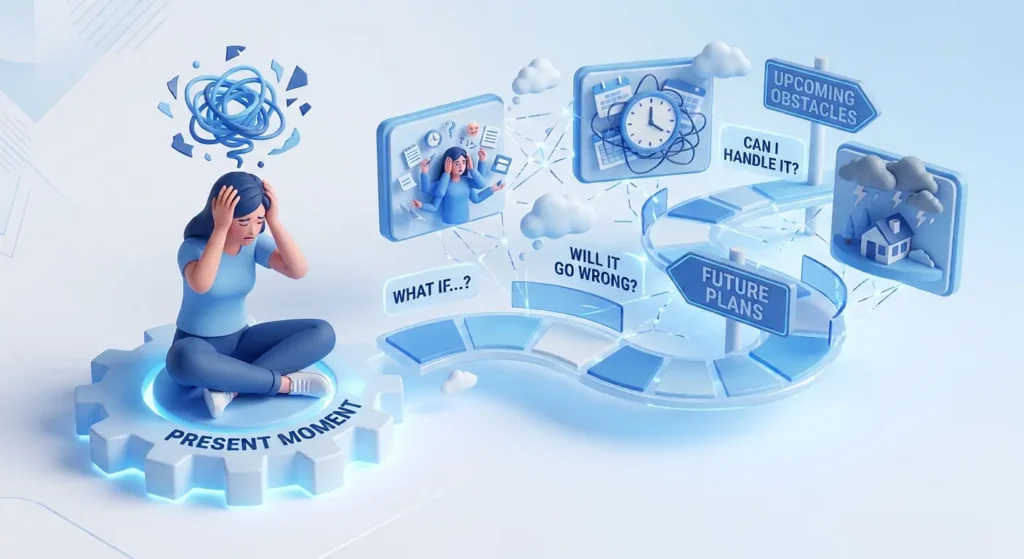
Last week I spent almost two hours lying awake, rehearsing a conversation that was never going to happen the way I imagined it. I had the whole script written in my head: what I’d say, how the other person would react, what I’d say back, and how it would all go wrong. By the time I fell asleep, I was exhausted, and the thing I was so worried about hadn’t even started.
If that sounds familiar, you probably know what I’m talking about. It’s called anticipatory anxiety, and for a long time I didn’t know it had a name. I just thought I was “someone who overthinks.”
So, what is it exactly?
Anticipatory anxiety is the stress and worry you feel about something that hasn’t happened yet. It could be a job interview next week, a doctor’s appointment, a difficult talk with a friend, an exam, or even something as small as a phone call you’ve been putting off.
The strange part is that your body doesn’t know the difference between a real threat and an imagined one. Your heart races, your stomach tightens, and your thoughts spiral, and all of it is triggered by a what-if.
How it shows up for me
For me, it rarely looks like panic. It’s quieter than that:
- I can’t focus on what I’m doing because part of my mind is already in the future.
- I replay conversations that haven’t happened, over and over.
- I imagine the worst-case scenario as though it’s the most likely one.
- My sleep gets worse, usually the night before something “important.”
- I feel tired for no obvious reason, because worrying burns more energy than we admit.
And here’s the thing that frustrated me most: the event itself usually turned out fine. Sometimes it was even good. But I had already suffered through it a dozen times in my head before it arrived.
Why does our mind do this?
From what I’ve read, our brains are wired to protect us. Thinking ahead and preparing for danger helped our ancestors survive. The problem is that the same system now fires up over emails, deadlines, and social situations.
Your brain is trying to help. It just doesn’t know when to stop. It treats uncertainty as danger, and since the future is always uncertain, it always has something to worry about.
What has actually helped me
I’m not a doctor, and I won’t pretend I’ve figured it all out. But a few small things have made a real difference for me:
- Naming it: Saying “this is anticipatory anxiety” out loud, or even in my head, takes away some of its power. It stops feeling like a prediction and starts feeling like a pattern I recognize.
- Asking, “What do I actually know right now?”: Anxiety lives in the what ifs. When I pull myself back to the facts, such as what’s confirmed and what’s within my control, the noise gets quieter.
- Writing it down: If my thoughts are racing at night, I dump everything onto paper. It’s like telling my brain, “Okay, I’ve stored this; you don’t have to hold it anymore.”
- Preparing, then stopping: There’s a difference between preparing and ruminating. Preparing has an endpoint. Ruminating just loops. I give myself a set amount of time to plan, and when it’s up, I move on.
- Slowing my breathing: It sounds too simple, but a few slow breaths with a longer exhale really do calm my body down. The physical part of anxiety often needs to be dealt with before the thoughts will settle.
- Remembering my track record: I remind myself of the times I was sure something would go badly and it didn’t. I’ve handled hard things before, and I’ll handle this too.
A gentle reminder
If your anxiety feels constant, overwhelming, or starts getting in the way of your daily life, please don’t just tough it out. Talking to a counselor or doctor isn’t a sign of weakness. It’s one of the most useful things you can do for yourself.
Final thoughts
I’ve realized that most of my anxiety is me suffering in advance, paying for something before I even know if the bill will arrive. I still do it sometimes. But now I catch myself a little earlier, take a breath, and come back to today.
“The future will get here on its own. I don’t have to live through it twice.”
If you struggle with this too, I’d love to hear how you cope. Sometimes just knowing we’re not the only ones makes the load a bit lighter.