
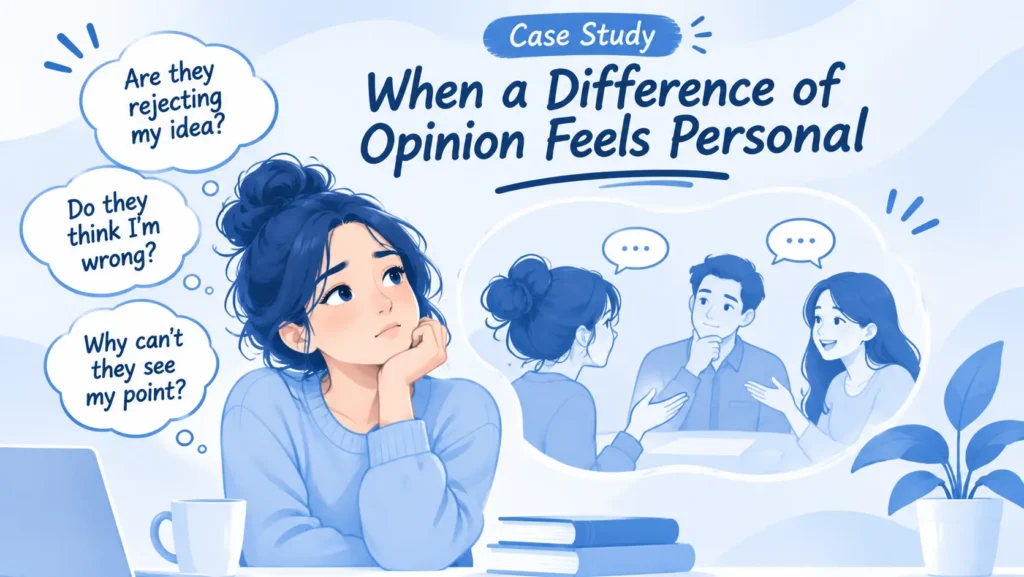
1. The Situation
Consider someone who finds it difficult to remain comfortable when another person disagrees with their opinion.
At work, they participate in a team discussion about how to complete a project. They suggest an approach that they believe will make the process easier. However, a colleague responds, “I don’t think that approach will work. We should consider another option.”
The colleague may simply be expressing a different perspective. But the person immediately feels uncomfortable.
They begin thinking:
- “Why are they rejecting my idea?”
- “Do they think I don’t know what I’m doing?”
- “Why can’t they understand my point?”
Instead of discussing the suggestion further, they become defensive. They may try to justify every detail, interrupt the other person’s explanation, or stop participating in the discussion altogether.
The same pattern appears in their personal relationships. For example, a friend may suggest a different way to spend the weekend. A family member may disagree with a decision they have made. Even when the disagreement is expressed calmly, the person sometimes experiences it as a personal rejection.
Later, they continue thinking about the conversation. They remember the other person’s words, consider what they could have said differently, and wonder why their opinion was not accepted.
Over time, disagreements become emotionally tiring. They may avoid discussing certain subjects with people they know, or feel the need to convince others before they can move forward.
The difficulty is not simply that people have different opinions. It is that disagreement can make them feel personally dismissed or misunderstood. They want others to understand their perspective, but they also find it difficult to accept that someone can respect them while seeing a situation differently.
2. Psychological Understanding
This situation can be explored through psychological concepts related to thinking patterns, emotional responses, and interpersonal communication.
Personalisation
Personalisation is a cognitive distortion in which someone interprets an event as being directly about themselves, even when there may be other explanations. For example, when a colleague disagrees with an idea, the person may interpret it as a judgement of their intelligence or ability. However, disagreement with an idea does not automatically mean rejection of the person who expressed it. The distinction between these two things can be difficult to recognise when emotions are involved.
Emotional Reasoning
Emotional reasoning occurs when someone assumes that because they feel something strongly, their interpretation must be true. For instance, a person may feel embarrassed or rejected during a discussion and conclude that the other person intended to disrespect them. Their emotional experience is real, but it does not necessarily confirm the intention behind the other person’s response. Learning to recognise this difference can help create space between an emotional reaction and the meaning assigned to an event.
Cognitive Rigidity
Cognitive rigidity refers to difficulty adjusting one’s thinking when presented with different information or perspectives. A person may become strongly attached to their original idea and find it uncomfortable to consider an alternative. This does not necessarily mean they believe their opinion is always correct; sometimes, changing their position can feel like losing an argument or admitting that their initial thinking was wrong. Developing cognitive flexibility helps people consider other viewpoints without feeling that they must immediately abandon their own.
Emotional Regulation
Disagreement can bring feelings such as frustration, embarrassment, disappointment, or anger. When these emotions become intense, people may respond quickly instead of taking time to understand the situation. Emotional regulation involves recognising these feelings and responding in a more considered way rather than allowing the first reaction to control the conversation. It is also important to recognise that some disagreements genuinely involve disrespectful communication. Understanding one’s emotional response does not mean accepting rude or hurtful treatment.
3. Insights & Approaches
The aim in this situation is not to make the person agree with everyone. It is to help them recognise that two people can have different perspectives without the interaction becoming a personal conflict.
Separate the Opinion from the Person: When someone disagrees, the person can pause and consider what was actually being questioned. Was the other person disagreeing with the idea, the method, or the decision? Or did they genuinely make a personal remark? Separating the content of the discussion from its emotional interpretation can prevent unnecessary conflict.
Recognise the Emotion Before Responding: Instead of immediately defending their opinion, the person can identify what they are experiencing. They might ask themselves:
- Am I feeling rejected, embarrassed, or frustrated?
- What exactly made this disagreement uncomfortable?
- Am I responding to what the person said or what I think they meant?
Practise Curiosity Towards Different Perspectives: Rather than treating disagreement as something that needs to be won, the person can approach it as an opportunity to understand another viewpoint. They could ask: “Can you explain why you prefer that approach?”, “What do you think might work better?”, or “Is there something I haven’t considered?” These questions allow the discussion to continue without requiring either person to immediately change their position.
Communicate Disagreement Respectfully: The person can practise expressing their own opinion without becoming defensive. For example: “I understand your point, but I see this situation differently,” or “That is one way to approach it. I was considering another possibility.” Such responses allow individuals to maintain their own perspectives while acknowledging those of others.
Learn to Accept That Every Discussion Does Not Need an Agreement: Not every conversation needs to end with one person changing their mind. Sometimes, people can understand each other’s reasoning and still reach different conclusions. Accepting this possibility can reduce the pressure to prove that one’s opinion is correct and helps individuals recognise that respectful disagreement can exist within healthy relationships.
4. Key Learnings
This scenario highlights how disagreements can sometimes become emotionally difficult when people interpret different opinions as personal rejection. One important learning is that another person’s disagreement does not automatically reduce the value of our ideas, abilities, or identity.
People can respect one another while holding different perspectives. They can maintain their own opinions without needing everyone to agree with them. Developing this understanding requires emotional awareness, cognitive flexibility, and respectful communication.
“Someone can disagree with your opinion without rejecting you as a person. Both perspectives can exist without one needing to become a personal conflict.”