
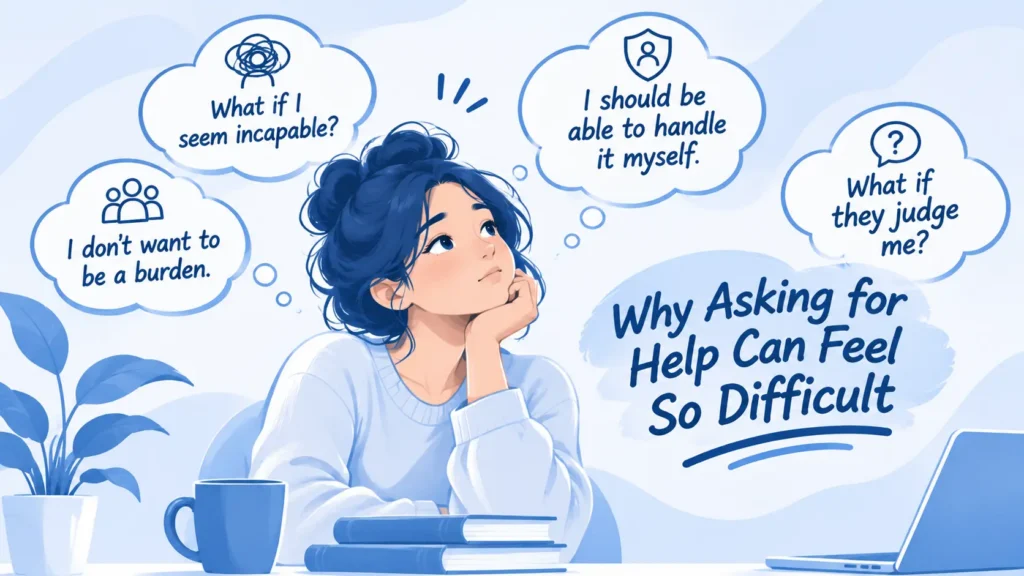
Have you ever needed someone’s help but decided not to ask?
Perhaps you were struggling with something at work, trying to manage several responsibilities, or going through a difficult personal situation. You knew that talking to someone might make things easier, but you kept telling yourself that you would manage.
Maybe you even started typing a message to a friend, only to delete it before sending. You might have thought:
- “They already have enough to deal with.”
- “I don’t want to disturb anyone.”
- “What if they think I’m incapable of handling this?”
- “Perhaps I should try a little harder on my own.”
So you continued managing everything by yourself.
From the outside, it may have looked like independence. But underneath, there might have been uncertainty, discomfort, or fear about letting someone see that you needed support.
Asking for help sounds like a simple thing to do. Yet for some people, it can feel surprisingly difficult. Why is it sometimes easier to struggle quietly than to tell someone we need a little help?
When You Are Used to Managing Everything Yourself
Some people become so accustomed to handling things independently that asking for help begins to feel unfamiliar.
They are usually the ones who organise things, solve problems, remember responsibilities, and try to manage difficult situations without involving anyone else. When something goes wrong, their first response is often, “I’ll figure it out.”
This may have worked well for them in many situations. Being independent can help people develop confidence, responsibility, and problem-solving skills. But there is a difference between being capable of handling things independently and believing that you must always handle everything alone.
Imagine someone who is managing a demanding job while also taking care of responsibilities at home. Their workload is increasing, they are struggling to find enough time, and they are beginning to feel exhausted. A family member offers to help, but they immediately reply, “No, it’s okay. I’ll manage.”
They might genuinely believe that accepting help is unnecessary. Or perhaps asking someone else to take responsibility feels uncomfortable. Even when support is available, they continue carrying everything themselves.
Sometimes, the habit of independence becomes so strong that we forget it is possible to share responsibilities.
The Fear of Becoming Someone Else’s Burden
One common reason people hesitate to ask for help is the feeling that their problems might become an inconvenience to others.
They may know that a friend would probably listen, but still wonder whether that friend has enough time or energy. They might think about the other person’s responsibilities before even considering their own need for support.
For example, someone has been feeling emotionally low for several days. They want to talk to a close friend, but they remember that the friend is also managing work, family commitments, and personal responsibilities. So they decide not to bring it up. They tell themselves that it can wait. Sometimes, they may even convince themselves that their problem is not important enough to mention.
The intention may come from consideration for another person. But repeatedly assuming that our needs will become a burden can make it difficult to allow others to support us.
There is an important difference between respecting someone’s availability and deciding on their behalf that they should not have to listen to us. We can give people the opportunity to decide whether they have the time and emotional space to help.
What If They Think Less of Me?
Asking for help can also feel uncomfortable because it requires us to reveal that we do not have everything under control. We may worry about how another person will interpret that.
- At work, someone might hesitate to ask a colleague for guidance because they fear appearing inexperienced.
- A student may avoid asking a teacher to explain something again because they worry about looking unprepared.
- Someone going through a personal difficulty may avoid opening up because they do not want others to see them differently.
In each situation, the concern is not only about receiving help. It is also about how asking might affect the way others perceive us. We may believe that people will respect us more if we manage everything independently.
But needing assistance does not erase our abilities. A person can be responsible and still need guidance. Someone can be experienced and still have questions. A capable individual can also go through a period when things become difficult to manage.
Being able to recognise when we need support is not the opposite of independence. It is part of understanding our own limitations.
When Previous Experiences Make Asking Harder
Our willingness to ask for help can sometimes be influenced by what happened when we asked in the past.
Imagine someone who once shared a personal problem with a friend but received a dismissive response. Perhaps the friend said, “You’re making too much of it,” or quickly changed the subject. The person may have felt embarrassed or misunderstood.
The next time they experience something difficult, they might remember that interaction. Even if another person is willing to listen, they may hesitate. They might think:
- “What if they react the same way?”
- “What if they don’t understand?”
- “What if I regret telling them?”
Previous experiences can shape what we expect from future conversations. When an earlier request for support did not feel safe, reaching out again may require more trust. However, one person’s response does not necessarily tell us how everyone will respond.
It may help to be thoughtful about whom we approach, what we share, and what kind of support we are looking for. Not everyone needs to know everything about us. But we also do not have to keep every difficulty to ourselves.
We May Not Know What Kind of Help We Need
Sometimes, the difficulty is not simply asking. It is knowing what to ask for. You may feel that something is becoming difficult, but you cannot identify exactly what would make things easier.
- Perhaps you want someone to listen, but you do not want advice.
- Maybe you need practical assistance but feel uncomfortable explaining why you cannot manage alone.
- Or perhaps you want another person’s perspective because you have been thinking about the same situation repeatedly.
When the need is unclear, starting a conversation can become harder. For example, someone going through a stressful period may tell a friend, “I’m not doing very well.” But when the friend asks, “What happened?” they struggle to explain. They may worry about saying too much, leaving out important details, or not making sense.
This does not mean their experience is not worth sharing. We do not always need a perfectly organised explanation before reaching out. Sometimes, beginning with a simple statement is enough:
“I’ve had a difficult week, and I think I could use someone to talk to.”
It is okay to understand what you need gradually.
Asking for Help Does Not Have to Be a Big Conversation
For someone who finds asking difficult, the idea of suddenly opening up about everything may feel overwhelming. But reaching out does not have to begin with a long explanation. It can start with something small and specific. For instance:
- “I’m finding this task difficult. Could you help me understand the first step?”
- “Do you have some time to talk? I’ve had a lot on my mind.”
- “Would you be able to help me with this responsibility today?”
- “I don’t really need advice right now. I would just like someone to listen.”
Being clear about what we need can make the conversation easier for both people. It also gives the other person an opportunity to respond honestly. They might be available immediately, suggest another time, or explain that they cannot help at that moment. Their availability does not determine whether our need was valid.
We can also begin with someone we already trust rather than feeling pressured to share something personal with someone we barely know.
Learning That Support Can Be Part of Independence
There is a common idea that a strong person should be able to manage everything alone. But independence does not have to mean doing everything without assistance.
Think about everyday life. We learn from teachers, receive guidance from colleagues, depend on family members in different situations, and seek professional advice when something requires specialised knowledge. We do not usually consider these things failures. Yet when it comes to emotional or personal difficulties, we sometimes apply a different standard to ourselves. We expect ourselves to find every answer independently.
Perhaps it is worth questioning that expectation.
Healthy support does not always mean someone solving our problems for us. Sometimes, it means having another person listen, helping us see a situation differently, or sharing a responsibility that has become difficult to manage. We can still make our own decisions while allowing others to support us.
And we can receive help today while being the person who offers help tomorrow. Relationships do not always have to involve one person being the strong one and another being the one who needs support. There should be room for both.
A Small Check-In
Think about a recent situation when you needed help but chose not to ask for it. Perhaps you were dealing with a responsibility, trying to understand something, or going through a personal experience that you did not want to share. Take a moment to reflect on these questions:
- When I need help, what is usually the first reason I hesitate to ask?
- Do I worry that I might disturb someone or become a burden?
- Have previous experiences made me uncomfortable about depending on others?
- What kind of support would actually make things easier for me?
- Is there one person I could comfortably approach when I need support?
You do not have to share everything with everyone. You are allowed to choose the people you trust and decide what you feel comfortable discussing. But remember that you do not have to wait until everything becomes difficult before asking someone to stand beside you.
“Sometimes, allowing another person to help is not a sign that you cannot manage your life. It is simply recognising that you were never required to manage every part of it alone.”
Take your time. There is no right or wrong answer.