
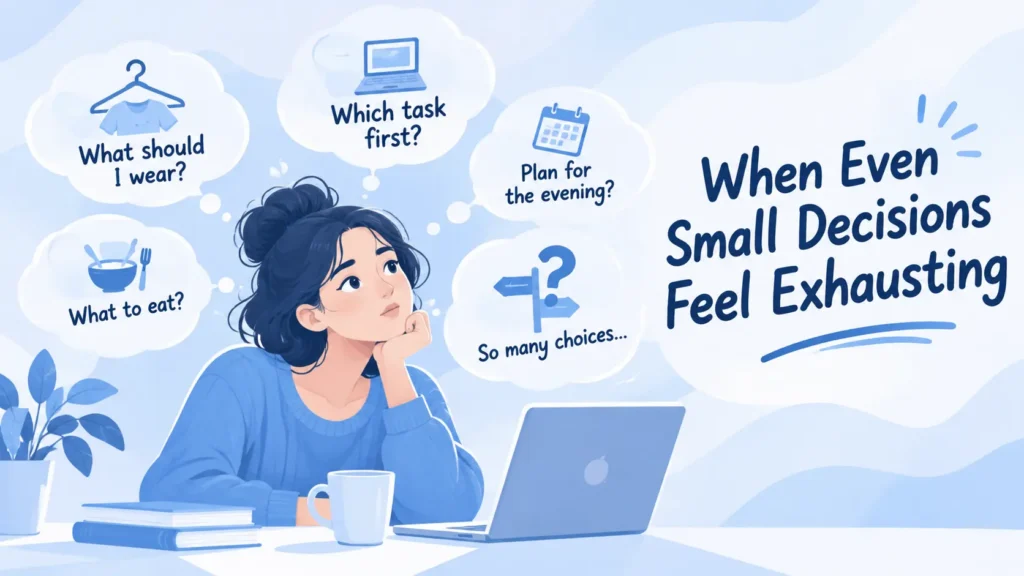
Have you ever opened your wardrobe and spent several minutes deciding what to wear? Or looked at a food menu and felt too tired to choose something? Perhaps someone asked you a simple question, such as, “What would you like to do today?” and you found yourself unable to give an answer.
The decision itself may not be important. It could be something as ordinary as choosing a meal, replying to a message, deciding what to watch, or planning your evening.
Yet, sometimes, even these little choices feel surprisingly difficult.
We often assume that making decisions should be easy. After all, we make hundreds of choices every day. But what happens when our minds begin to feel tired of choosing?
Sometimes, it is not the decision that feels difficult. It is everything happening around it.
When Every Choice Starts to Feel Like a Task
Think about how your day usually begins.
You decide when to wake up, what to wear, what to eat, what needs to be done first, which messages need a reply, and how to manage the rest of your responsibilities.
Then more choices appear.
Should you finish one task before starting another? Should you accept an invitation? Should you take a break or continue working? Should you spend your evening resting or catching up on something you have postponed?
Individually, these decisions may seem small.
But when one choice follows another without much room to pause, the process can become tiring. You might notice yourself taking longer to decide, repeatedly changing your mind, or wishing someone else would simply make the choice for you.
This experience is sometimes described as decision fatigue. It refers to the mental tiredness that can develop when we face repeated decisions and demands on our attention.
It does not mean that you are incapable of making decisions. It may simply mean that your mind has been handling too many choices without enough rest.
The Hidden Questions Behind a Simple Decision
Sometimes, the difficulty is not about choosing between two options. It is about everything we imagine might happen after choosing.
Consider a simple example.
A friend invites you to an outing. You would like to go, but you also have other responsibilities.
Immediately, several questions appear:
- Will I have enough time?
- What if I regret going?
- What if I miss something important?
- What if I say no and disappoint my friend?
- What if I say yes and feel tired later?
A simple invitation has suddenly become a series of possibilities to consider.
This can happen in many areas of life. Choosing a course, accepting a new responsibility, buying something, changing a routine, or even planning a holiday can bring more questions than expected.
Sometimes, we are not just trying to make a choice. We are trying to predict every possible outcome before making it.
And that can make even an ordinary decision feel much heavier.
The Search for the Perfect Choice
Another reason decisions become exhausting is the expectation that we must always choose correctly.
We may spend a long time comparing options, looking for more information, asking different people for opinions, or imagining what could go wrong.
We tell ourselves that if we think about it a little longer, we will eventually find the perfect answer.
But not every decision has a perfect answer.
Sometimes, two options are equally reasonable. Sometimes, we cannot know what will happen until we try. And sometimes, a decision that seems right today may need to be adjusted later.
The pressure to avoid mistakes can make us question choices that are already good enough.
For example, someone choosing between two job opportunities might continue comparing every detail even after identifying the option that best matches their needs.
They may worry about salary, location, future opportunities, work culture, and what others might think.
Considering these factors is useful. But repeatedly going through the same questions without gaining new information can leave a person feeling more confused rather than more certain.
Making a thoughtful decision does not require knowing everything in advance.
When We Keep Asking Others What We Should Do
Seeking another person’s opinion can be helpful. Sometimes, a different perspective allows us to notice something we had not considered.
However, there may be moments when we ask several people the same question, hoping someone will give us the answer that finally removes all doubt.
One person says, “Choose the first option.” Another says, “I think the second one is better.” A third person offers a completely different suggestion.
Instead of feeling clearer, we become even more uncertain.
This can happen when we begin relying on other people’s opinions more than our own preferences and priorities.
We may slowly lose touch with a simple question: What do I actually want?
Listening to others is not wrong. But their opinions do not have to replace our own judgment.
A useful approach is to understand why someone recommends a particular choice, consider whether their advice fits our situation, and then give ourselves space to decide.
You Do Not Have to Decide Everything at Once
When several decisions are waiting for us, it can feel as though everything needs an immediate answer.
But not every choice has the same level of importance or urgency.
Some decisions need attention now. Others can wait. Some can be made quickly, while others deserve more time and information.
Learning to recognise this difference can make everyday life feel less crowded.
For example, choosing what to eat for lunch probably does not require the same amount of consideration as deciding whether to move to another city.
Giving every decision equal attention can use more mental energy than necessary.
You can begin by asking yourself:
- Does this decision really need to be made right now?
- What information do I actually need?
- Am I considering something new, or repeating the same thoughts?
- Can I make a reasonable choice and adjust it later if needed?
These questions are not meant to rush you. They are simply a way to separate what needs your attention from what does not.
Allow Some Decisions to Be Simple
We sometimes make everyday life more complicated by believing that every choice deserves careful analysis.
But there are situations where a simple decision is enough.
You do not always need to compare every restaurant before choosing where to eat. You do not need to find the perfect film before enjoying your evening. You do not have to create the ideal plan for every free hour.
You can choose something that works for now.
You can change your mind when circumstances change.
You can also decide that something is not important enough to spend more time thinking about.
This is not carelessness. It is recognising that your attention and energy are valuable.
When you stop treating every small choice as an important test, you may find more room for the things that genuinely matter.
A Little Space to Think Clearly
When decision-making begins to feel overwhelming, sometimes the most useful response is to pause.
Step away from the options for a moment. Take a breath. Have some water or do something that does not require another choice.
If possible, return to the decision when you feel more settled.
You can also try reducing the number of choices you face in everyday routines. For example, planning a few meals in advance, keeping a simple daily routine, or deciding on certain things ahead of time may reduce unnecessary decision-making.
The purpose is not to control every part of your day.
It is to make a little more space for yourself.
And remember, you are allowed to take time when a decision genuinely matters. You are also allowed to make a simple choice without turning it into a long internal discussion.
A Small Check-In
Take a moment to think about the decisions you have made recently.
Perhaps there was one choice you kept postponing, one situation where you asked too many people for advice, or one small decision that felt unexpectedly tiring.
Consider these questions:
- What kind of decisions have been taking up most of my mental energy lately?
- Do I sometimes keep thinking about a choice even after I have enough information?
- Am I trying to make the best possible decision, or am I afraid of making the wrong one?
- Is there one small decision I could make more simply this week?
You do not need to solve everything today.
Sometimes, making life a little lighter begins with recognising that not every choice needs all of your attention.
“Take your time. There is no right or wrong answer.”