
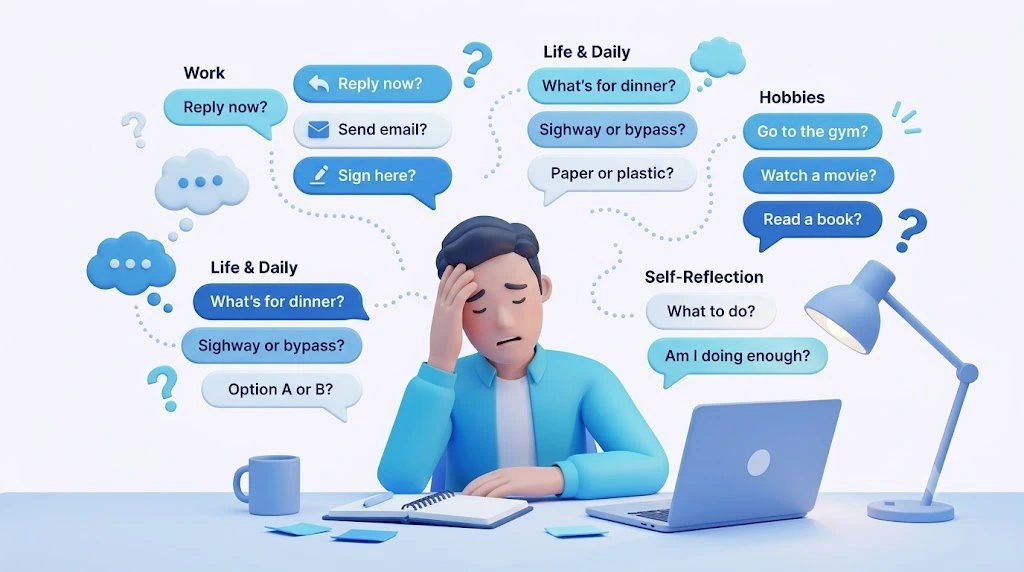
Have you ever had a long day at work and then felt completely stuck on what to eat for dinner? Or opened a streaming app, scrolled for twenty minutes, and ended up watching nothing?
I think most of us have been there. And when it happens, we usually blame ourselves. We say, “I’m so indecisive,” or “I’m just overthinking again.” But maybe the problem isn’t us. Maybe our mind is simply tired.
What Is Decision Fatigue?
Decision fatigue is that drained feeling we get after making too many choices in a day.
Think about a normal working day. You decide what to wear, what to have for breakfast, which task to start first, how to reply to an email, and how to handle a sudden problem. None of these feels big on its own. But they add up.
By evening, you have very little energy left. So when someone asks, “What should we cook tonight?”, it can feel strangely hard to answer. The question is simple, but your mind has already done a lot of work.
Why Do Small Decisions Feel So Heavy?
Making a decision takes focus, memory, and self-control. When we are tired, stressed, or distracted, these things don’t work as well.
Our minds are also carrying a lot at once. We remember tasks, check notifications, and make choices, all at the same time. When so much is going on, even a small decision can feel like one more thing on the pile.
Online shopping is a good example. You start with two options. Then you compare prices, read reviews, check details, and wonder if something better is out there. Before you know it, a small choice has become a big task.
Having more options doesn’t always make us happier, either. Sometimes it just makes it harder to feel sure about what we picked.
It’s Not the Same for Everyone
I don’t think decision fatigue works the same way for every person. Sleep, stress, mood, and even the place we are in can change how hard a choice feels. A decision that’s easy on a calm morning can feel impossible on a tiring evening.
It’s also not a medical problem. It’s just a way to describe those moments when our mind has had enough. And not every moment of confusion is caused by it.
How It Shows Up in Daily Life
Here are some signs you might notice:
- Putting things off. Even simple tasks get delayed because choosing feels like too much effort.
- Taking the easiest option. You pick whatever needs the least thinking.
- Feeling irritable. Small questions start to feel annoying after a long day.
- Overthinking. You compare things again and again because you don’t want to choose wrong.
- Avoiding the decision. You let someone else decide, or you keep waiting until later.
These habits can have other reasons too. But once we notice them, we can respond with a bit more kindness and care.
What Can Help?
The goal isn’t to stop making decisions. That’s impossible. The goal is to make everyday decisions lighter.
1. Keep routine choices simple.
A basic morning routine, planned meals, or a regular schedule means fewer things to decide from scratch.
2. Save your energy for what matters.
Not every decision needs the same amount of thought. Give your best energy to the important ones, and don’t spend too long on small details.
3. Take real breaks.
Step away for a few minutes. Walk, stretch, or just stay away from your phone. Good sleep and rest help too.
4. Limit your options.
Instead of comparing twenty things, narrow it down to two or three. That’s usually enough.
5. Notice when you’re overthinking.
Ask yourself, “Does this really need more thought, or am I just trying to be 100% sure?” For small, everyday choices, “good enough” is perfectly fine.
6. Check how you’re feeling.
If you’re hungry, stressed, or exhausted, ask yourself if the decision can wait until you feel calmer. Some choices really do get easier after food, rest, or a short pause.
One Last Thought
Every day, we are asked to choose, compare, reply, and decide. From the time we wake up until we go to bed, our attention keeps getting pulled in different directions.
Maybe the answer isn’t to become better at every single decision. Maybe it’s to understand which ones truly deserve our attention, and let the rest be simple.
So the next time a small choice feels impossible, try not to judge yourself. You may not be indecisive at all. You may just have too much on your mind and need some rest.
Sometimes a hard decision is simply a sign to slow down, simplify, and give your mind some space.