
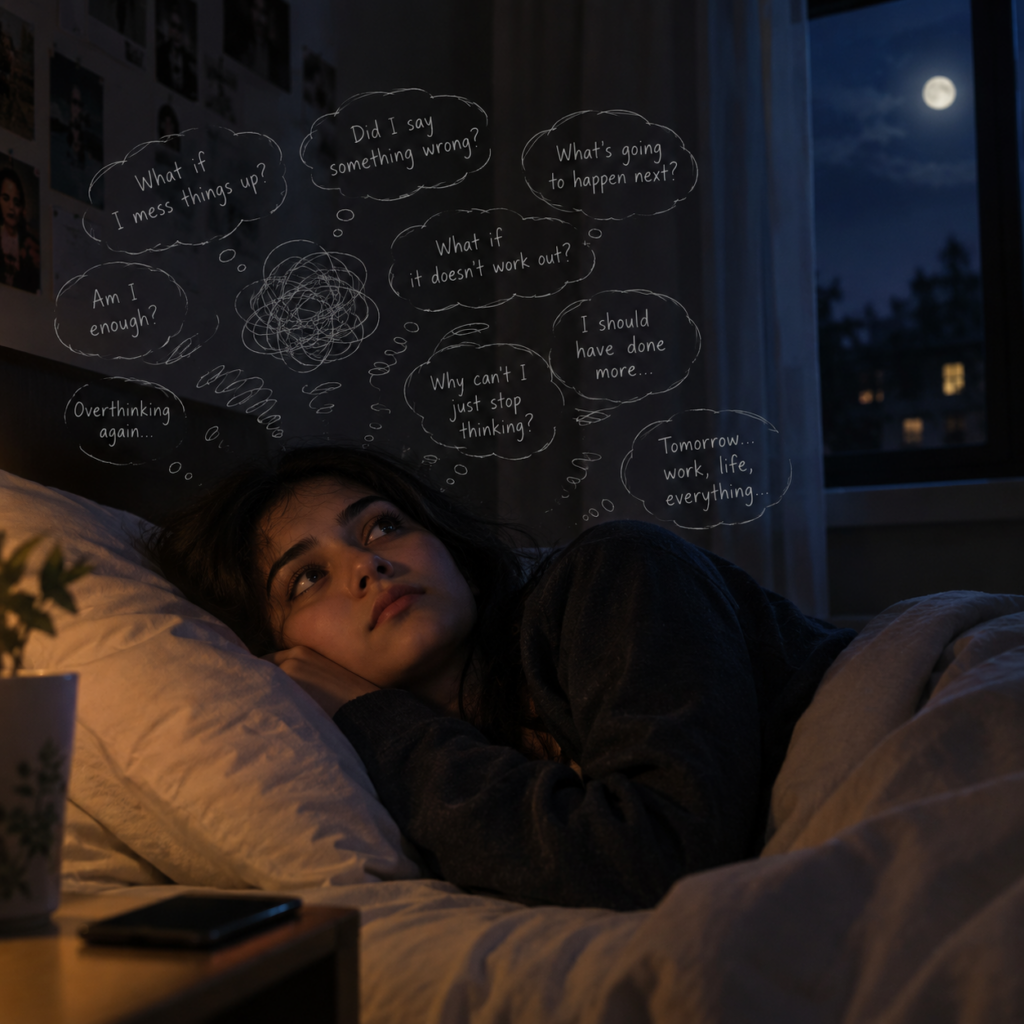
Some of my worst overthinking happens between 11 PM and 2 AM.
It’s usually nothing dramatic. Sometimes it’s a conversation I had a few days ago that suddenly comes back to me. Sometimes it’s something small I said at work, and somehow my brain turns it into a question about whether I messed everything up.
The strange part is that most of these things don’t bother me that much during the day. But at night, they feel different. A small thought can suddenly feel very important, like I need to figure it out before I can sleep.
For a long time, I thought I was just bad at switching my brain off. But I think there’s a little more to it.
Why Does Everything Feel Bigger at Night?
During the day, there is always something happening. Messages, work, conversations, errands, people around us, notifications… our attention is constantly being pulled somewhere.
At night, all of that becomes quiet.
And that’s usually when the thoughts we pushed aside during the day start showing up.
Sometimes I’ll be lying in bed thinking about something completely random, and then suddenly I’m remembering an awkward conversation from last week. Then I start thinking about what I should have said. Then what the other person might have thought. Then another completely unrelated worry appears.
And somehow, twenty minutes have passed.
Being tired doesn’t really help either. When I’m exhausted, I don’t have the same energy to look at things calmly. Something that would probably seem small in the afternoon can feel like a serious problem at midnight.
But Is All Thinking Actually Overthinking?
This was something I had to learn.
There is a difference between thinking about something and getting stuck in it.
Reflection can actually be useful. You think about what happened, understand what you could do differently, and maybe decide what to do next.
Rumination is different. It’s when the same thought keeps coming back without really taking you anywhere.
It’s more like:
- Why did I say that?
- What if they misunderstood me?
- Why am I always like this?
- What if something goes wrong?
And then you go through the same questions again.
The annoying part is that rumination can feel productive. You feel like you’re trying to solve something when really you’re just going around in circles.
I’ve definitely confused the two before.
And Then There’s the Phone…
When I can’t sleep, my first instinct is usually to reach for my phone.
Which, honestly, isn’t always the best idea.
I’ll tell myself I’m just going to check something for a minute, and suddenly I’m scrolling through Instagram or watching random videos. Sometimes I’ll open my notes and start writing everything that’s bothering me.
Writing things down can help, but I’ve realized that it doesn’t automatically mean I’m processing my feelings. If I’m writing the same worry in five different ways, I’m probably just thinking about it even more.
And sometimes the phone just gives my brain something else to stay awake for.
So Can Technology Actually Help?
I think it can. But only if we use it differently.
A mental health tool shouldn’t make me feel like I have another task to complete at the end of an already exhausting day.
If I were designing something specifically for those late-night moments, I’d want it to be simple.
Something with a clear beginning and an ending.
I don’t necessarily want to have a twenty-minute conversation with an app when I’m already tired. Sometimes I just need a few minutes to sort out what’s actually bothering me and then stop.
Questions that help me move forward.
Instead of asking me how I feel ten different ways, it could ask something like:
“What do you actually know about this situation, and what are you assuming?”
Or:
“Is there anything you can realistically do about this tonight?”
Sometimes the answer is simply no.
And that’s okay.
A place to leave the thought for tomorrow.
One thing that helps me is writing down what I’ll deal with tomorrow instead of trying to solve everything at 1 AM. Something as simple as:
“I’ll think about this tomorrow at 10 AM.”
It sounds almost too simple, but sometimes my brain just needs to know that I’m not ignoring the problem.
No unnecessary stimulation.
No endless scrolling. No streaks. No notifications telling me to come back. No feeling that I need to keep interacting with the app.
If it’s supposed to help me sleep, it shouldn’t give me another reason to stay awake.
And if I’m clearly going around the same thought again and again, maybe the best response isn’t another question.
Maybe it’s:
“You’ve thought about this enough for tonight. You can come back to it tomorrow.”
What I’ve Started Doing
I’m definitely not someone who has completely figured this out. But a few small things have helped.
I keep a notebook near my bed. If something is bothering me, I’ll write it down instead of keeping it in my head. Usually just one or two lines. Sometimes I’ll also write what I can do about it tomorrow.
I also try to keep my phone a little further away. Not always successfully, but I’m trying.
And I’ve started reminding myself that a thought feeling extremely important at 1 AM doesn’t necessarily mean it actually is.
Sometimes I’m just tired.
Most things don’t magically disappear in the morning. But they often feel a little less overwhelming.
Maybe that’s the thing about nighttime overthinking. The goal isn’t to completely stop your thoughts. That’s probably impossible.
It’s more about noticing when you’re actually thinking something through and when you’ve started going around in circles.
And sometimes, instead of finding the perfect answer at 1 AM, the healthiest thing you can do is write it down, leave it for tomorrow, and let yourself sleep.