
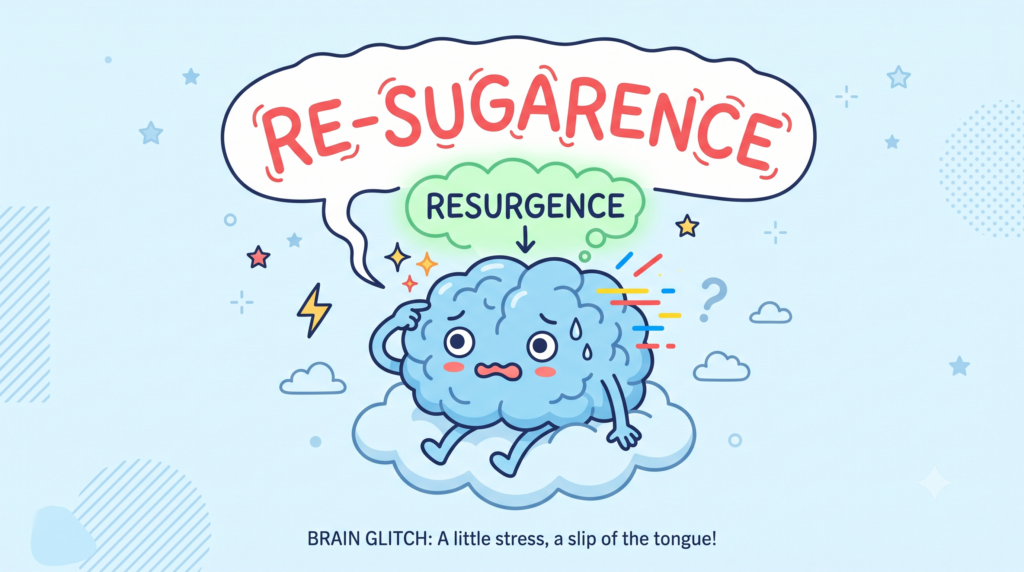
Recently, I made what I consider one of the dumbest mistakes possible.
I was going through a proposal with my colleague. There was this word: resurgence.
A perfectly normal word. A word I know. I know what it means. I know how it is pronounced. I have probably seen it approximately 300 times in my life.
And yet, on that particular day, my brain looked at it and confidently went:
“Re-sugarence.”
Yes.
Re-sugarence.
I don’t even know what that means.
For a solid few seconds, I was internally trying to understand this mysterious new vocabulary.
What is re-sugarence? Is it a technical term? Did I miss something? Why does this word look familiar but also completely wrong?
And the worst part?
My colleague didn’t laugh.
He didn’t point it out.
He didn’t say, “What did you just read?”
He simply said:
“Resurgence.”
And suddenly, my brain rebooted.
Oh.
Resurgence.
I KNOW THAT WORD.
So why did my brain just betray me?
Turns out, your brain doesn’t read like a dictionary.
When we read, our brains aren’t necessarily processing every single letter individually. We’re constantly using context, previous knowledge, visual patterns and expectations to make sense of what we’re seeing.
Which is incredibly efficient.
Until it isn’t.
Sometimes your brain basically goes:
“I’ve seen enough of this word. I know what this is.”
And then proceeds to confidently produce something that belongs nowhere in the English language.
This becomes even more likely when you’re tired, distracted, rushing, overloaded or stressed.
Your brain has limited attentional resources. When you’re mentally juggling ten things at once, it may rely more heavily on shortcuts and predictions instead of carefully analysing every piece of information.
So sometimes you don’t actually forget a word.
You simply process it incorrectly for a moment.
Stress can make these tiny glitches more noticeable.
Stress doesn’t mean your brain suddenly stops working.
But when you’re under pressure, attention and working memory can become less efficient. You may find yourself rereading the same sentence, forgetting why you opened an app, walking into a room and immediately forgetting why, struggling to retrieve a familiar word, or looking at a very normal word and thinking:
“That cannot possibly be a real word.”
These experiences are generally not evidence that your vocabulary has disappeared.
They’re often just small examples of how imperfect human attention and memory are.
And ironically, the more anxious you become about making a mistake, the more you may notice every tiny mistake.
Which creates the beautiful cycle:
Make a tiny mistake → notice it → panic about the mistake → become hyperaware → make another tiny mistake → question your entire intellectual existence.
Very efficient system.
10/10 brain design.
And then there’s the embarrassment.
What stayed with me wasn’t even the word.
It was the immediate feeling of:
“Oh my God. Did he notice?”
Because somehow, making one tiny reading error can make us feel like we’ve just publicly revealed that we’ve been pretending to know English our entire lives.
But my colleague’s response was actually a nice reminder.
He just corrected the word naturally.
No laughing.
No teasing.
No dramatic pause.
Just:
“Resurgence.”
And we moved on.
Which made me realise something else:
Sometimes we experience our own mistakes at 10 times the volume that other people do.
To me, it was a full internal documentary.
To him, it was probably:
“She read a word wrong.” End credits.
So, if your brain randomly turns a familiar word into “re-sugarence” one day…
Maybe don’t immediately conclude that something is wrong with you.
Check the basics first:
- Have you slept?
- Are you stressed?
- Are you multitasking?
- Are you rushing?
- Have you been staring at a screen for six hours?
- Are you mentally thinking about seventeen other things?
Because sometimes the brain isn’t failing.
It’s just taking a shortcut that went spectacularly off-road.
And honestly?
I’m choosing to believe “re-sugarence” was not a mistake.
It was simply a limited-edition word released by my brain.
Unfortunately, the dictionary refused to recognise it.